

The Wedding Debt Trap: How the Quest for Splendor Is Bankrupting Africa’s Future

Across Accra, Lagos, and Nairobi, middle-class couples are financing single-day celebrations that cost multiples of their annual income, and calling the wreckage love.

At 11:47 on a Saturday morning in Osu, Accra, Adjoa Mensah stood in a bridal suite she could not afford, wearing a gown that cost more than her car. She was twenty-nine, a mid-level marketing executive at a fintech startup, and in forty minutes she would walk down an aisle flanked by three hundred guests, most of whom she had never met. Her fiancé, Kofi, a civil engineer, was in the parking lot on the phone with a loan officer, confirming that a personal loan of GHS 45,000 had cleared into their account that morning. It was the second loan they had taken in three months. The first had covered the traditional ceremony. This one would cover the white wedding, the reception, and the photographer whose Instagram portfolio had convinced them both that anything less would be settling.
By the time the couple cut their five-tier cake that evening, they had spent the equivalent of nearly three years of Adjoa’s gross salary on a single day. They did not know this yet. They would learn it slowly, in monthly instalments, over the next forty-eight months.
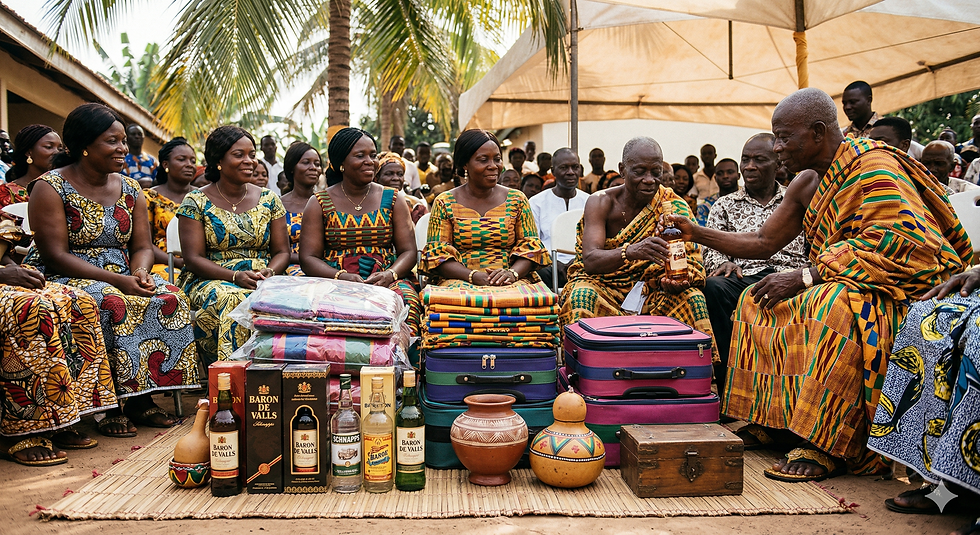
Adjoa and Kofi are not reckless. They are typical. Across Africa’s fastest-growing cities, Accra, Lagos, Nairobi, Johannesburg, a subtle financial crisis is unfolding inside wedding halls and reception marquees. Middle-class couples, propelled by social media aesthetics, family expectations, and an increasingly commercialized wedding industry, are spending multiples of their annual household income on ceremonies that last fewer than twelve hours. The result is the opening chapter of a debt spiral that corrodes the very marriage it was meant to consecrate. This is not a cultural problem. It is a consumer debt crisis hiding in plain sight, dressed in lace and kente.

The numbers are staggering when placed against the economic realities of the people spending them. In Ghana, the median monthly salary sits at approximately GHS 2,300, roughly $185. A moderate middle-class wedding in Accra, covering both the traditional engagement and a white ceremony with reception for 150 to 200 guests, routinely costs between GHS 80,000 and GHS 150,000. At the higher end, luxury celebrations cross GHS 800,000. Even at the moderate tier, a couple is spending the equivalent of nearly three years of a single median income on a one-day event. In a country where inflation ran at up 22.8% in 2024 and real wages have declined by an estimated 46% since 2020 when adjusted for purchasing power, the mathematics of this expenditure are not romantic. They are ruinous.
Nigeria tells a parallel story at a larger scale. A 2025 report by Cowrywise, the Nigerian fintech platform, found that the average wedding among young working couples now costs approximately ₦13 million, with celebrations ranging from ₦200,000 for intimate events to over ₦20 million for luxury affairs. In Lagos, where venue costs alone can consume ₦3 million to ₦10 million for a single day on Lagos Island, the wedding has become a production budget rivalling a small business launch. The three-tier system, traditional ceremony, registry, and white wedding, means couples are effectively financing three separate events, each with its own logistics, vendors, and social expectations.
In Kenya, the picture is no less alarming. A survey cited by Africa Business Insider estimated the average Kenyan wedding between KSh 2.5 million and KSh 5 million, with many middle-income couples struggling to stay below KSh 1.5 million. For a country where formal-sector salaries in Nairobi hover around $400–$600 monthly for many professionals, even a “modest” celebration of 200 guests at KSh 1 million represents years of savings consumed in a single afternoon.

What makes this crisis distinctly African is not the spending itself; Americans, after all, average over $35,000 per wedding, but the ratio of expenditure to income. When a couple in New York spends $40,000 on a wedding, that sum represents roughly 55% of the median American household income. When a couple in Accra spends GHS 120,000, that figure can represent 400% or more of their combined median earnings. The financial physics are entirely different. One is a stretch. The other is a fracture.
The engine driving this fracture is not greed. It is a collision between three forces that, individually, are understandable, and collectively, are devastating.
The first is the industrialization of the African wedding. What was once a family-centred ritual administered by elders and aunties has become a vendor-driven marketplace. Wedding planners in Ghana now charge between GHS 12,500 and GHS 50,000 for coordination alone. Photographers command GHS 5,000 to GHS 15,000. Décor packages for 150 guests run GHS 15,000 to GHS 20,000. Each vendor category has professionalized, and each professionalization has added a line item that did not exist a generation ago. The wedding industry across Africa is no longer a cottage tradition. It is a commercial ecosystem with its own inflation rate, and that rate outpaces wages.
The second force is social media’s role as a pricing benchmark. Instagram and TikTok have democratized aspiration while destroying financial privacy. A couple in East Legon can now see, in real time, how a couple in Lekki decorated their reception; the suspended floral installations, the LED dance floors, the drone footage. What they cannot see is how that couple financed it: whether it was generational wealth, corporate sponsorship, or, more commonly, a quiet stack of credit card debt. The curated image becomes the standard. The invisible debt becomes someone else’s problem. And when a young marketing executive in Accra begins planning her wedding, the reference point is no longer her mother’s ceremony. It is a highlight reel engineered to generate engagement, not to reflect economic reality.

The third force is the one no one talks about at the reception: the family guest list as economic weapon. In collective cultures, a wedding is not a private event. It is a communal obligation. The bride’s mother invites her church and other social groups. The groom’s father adds his business associates. Uncles, cousins, former neighbours, and the woman who sold Kofi Brokeman outside the family house in 1997 all receive invitations, because to exclude them would be to insult the family’s social fabric. In Ghana, a “small” wedding of 150 guests is considered almost secretive. In Nigeria, 300 is a starting point, and 500 is unremarkable. Every additional guest is an additional plate, an additional chair, an additional gift bag, and the couple, not the uncle who extended the invitation, absorbs the cost.
The financial consequences of this spending pattern extend well beyond the wedding day. A U.S. News survey found that 56% of newlyweds went into some form of debt to finance their weddings, and in African contexts, where formal credit is less accessible, the borrowing often takes more punishing forms: high-interest personal loans, informal lenders, salary advances that mortgage future earnings, or, most insidiously, the quiet depletion of savings that were earmarked for a first home, a business, or a child’s education. In South Africa, the Commission for Gender Equality has documented cases where lobola and wedding costs financed through personal loans consumed nearly half of a couple’s combined income in monthly repayments within the first year of marriage.
As a counselor who has sat across from over 2,300 individuals and couples in nine years of practice, I can report with certainty that the pattern is consistent: the debt incurred for the wedding metastasizes into the marriage. Couples who begin their unions in financial deficit do not argue about love. They argue about money. They argue about whose family demanded the larger guest list. They argue about whether the photographer was worth five thousand cedis when the transmission on the car needs replacing. The ceremony that was supposed to be the foundation of their partnership becomes, instead, the first crack in it. Financial stress does not arrive politely. It moves in and refuses to leave.
Here is an unsettling truth that the wedding industry, social media, and well-meaning family members will never tell you: the size of the wedding has no statistically meaningful correlation with the strength of the marriage. In fact, there is growing evidence that the relationship may be inverse. A widely cited study from Emory University found that couples who spent more than $20,000 on their wedding were 3.5 times more likely to divorce than those who spent between $5,000 and $10,000. The researchers’ explanation was not about money itself, but about what excessive spending revealed: a prioritization of performance over partnership, of external validation over internal alignment.

The African context makes this finding more urgent, not less. In cultures where community approval carries enormous weight, the temptation to prove love through spectacle is not vanity, it is survival instinct. The couple who “does it small” risks whispered judgment. The couple who “does it big” earns social capital...temporarily. But social capital does not compound. Debt does. And the couple who walks into a marriage carrying the financial equivalent of a small business loan, with nothing to show for it but a photo album and a pile of Tupperware and wall hangings from China Mall or Ice Chest from Melcom, has traded long-term economic mobility for short-term applause.
The solution is not to abandon celebration. It is to decouple the celebration from the debt. It is to recognize that a wedding is a ceremony, not a capital expenditure, and that the most radical act a young African couple can perform in 2026 is to marry within their means and invest the difference. A couple that spends GHS 30,000 on a wedding and puts GHS 90,000 into a joint investment account has not had a “cheap” wedding. They have made the first strategic financial decision of their marriage. They have chosen compound interest over compound regret.
Adjoa and Kofi will finish paying off their wedding in 2031. By then, their daughter will be 4 years old, and they will have spent more on a single Saturday in 2026 than they will have saved for her education in her entire life. They are not unusual. They are the template.

The African middle class is building something extraordinary; new industries, new cities, new possibilities. But it is simultaneously bleeding wealth through a ritual that has been captured by commerce and inflated by spectacle. The wedding debt trap is not a moral failure. It is a design flaw in how we have allowed celebration to be priced. And fixing it does not require rejecting tradition. It requires the courage to ask a question that no Instagram highlight reel will ever pose: What if the most beautiful thing about your wedding was that you could still afford your marriage the morning after?
PG Sebastian



Comments